Executive Summary
This report analyzes the advantages of the Kansai region (Osaka, Kobe, Kyoto) compared to the Greater Tokyo Area as a destination for real estate and business investments in Japan. While Tokyo remains Japan's economic center, recent years have seen declining yields due to soaring land prices and intensified competition. In contrast, the Kansai region offers relatively affordable asset prices, a rapid recovery in inbound tourism, and high potential for future capital gains through large-scale projects such as the Osaka-Kansai Expo and IR (Integrated Resort) development. From the perspectives of cost performance, growth potential, and quality of life, this analysis concludes that investment in the Kansai region is strategically advantageous and strong.

Strategic Entry Pricing
Regional Analysis of Japan's Real Estate Acquisition Costs
1. Asset Prices and Acquisition Cost Comparison
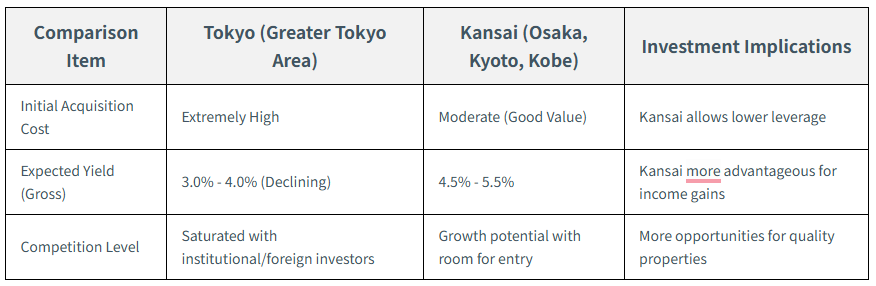
In terms of initial investment costs—one of the most critical factors in investment decisions—the Kansai region holds an overwhelming advantage over Tokyo. Real estate prices in central Tokyo have reached global levels, creating high barriers to entry.
1.1 Land Price and Property Price Disparity
Based on the Ministry of Land, Infrastructure, Transport and Tourism's land price announcement (2023–2024), average prices for commercial and residential land in the Osaka area are approximately 50–60% of those in the Tokyo area in many locations. This allows investors to secure better locations or build more extensive portfolios with equivalent budgets in the Kansai region.
2. Growth Potential and ROI (Return on Investment)
What determines investment attractiveness is not current prices but future growth potential. The Kansai area currently possesses the highest transformative energy of any region in Japan.
2.1 "Umekita Phase 2" and Osaka-Kansai Expo
The redevelopment area north of Osaka Station, "Grand Green Osaka (Umekita Phase 2)," is a massive project integrating offices, hotels, commercial facilities, and urban parks, serving as a catalyst for the Kansai economy. Furthermore, the 2025 Osaka-Kansai Expo will bring infrastructure improvements and enhanced international recognition, with economic effects predicted to continue as a legacy even after the event concludes.
2.2 IR (Integrated Resort) Opening Plan
The plan to open Japan's first IR on Yumeshima Island in Osaka will ensure long-term tourist inflow to the Kansai area and generate MICE (Meetings, Incentives, Conferences, and Exhibitions) demand. This represents a unique growth driver absent in Tokyo, with high ROI expected particularly for investments in hotels, vacation rentals, and commercial facilities.
3. Business Environment and Cost Structure.
Kyoto: For intrated with World Heritage sites and possessing irreplaceable cultural value. Demand for luxury hotels targeting wealthy clientele continues to exceed supply, facilitating high-margin business models.
Osaka: With its brand as a 'culinary capital' and vibrant nightlife, it enjoys high repeat visitor rates from across Asia.
Kobe: The exotic atmosphere of a port city combines with natural tourism resources such as the Rokko mountain range, offering high quality for residence and stays.
While Tokyo symbolizes 'business and bound demand, Kansai is at the core of the 'Golden Route' and possesses unique cultural strengths that surpass Tokyo.
From the perspectives of corporate expansion and startup investment, Kansai's cost advantages are substantial.
3.1 Office Rent and Operating Costs
Office rents in Osaka's major business districts (Umeda, Honmachi, Yodoyabashi) are approximately half to two-thirds of those in Tokyo (Marunouchi, Otemachi, Shibuya). Personnel costs also allow for securing talented individuals while controlling fixed expenses. This low-cost structure contributes to improved profit margins.
3.2 Startup Ecosystem
World-class research institutions such as Kyoto University and Osaka University are concentrated here, with active innovation creation in deep tech and life sciences fields. Kyoto City and Kobe City are proactive in startup support, offering unique subsidy programs and accelerator initiatives.
4. Quality of Life (QOL) and Residential Needs
The value of real estate as an investment is ultimately supported by actual demand—the desire to 'live' and 'work' there.
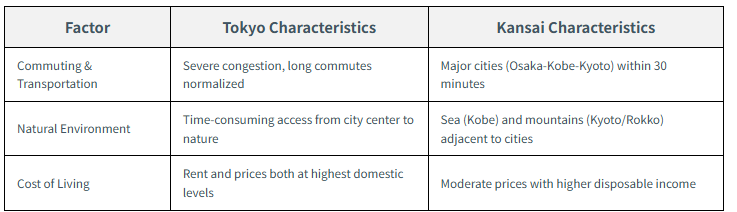
Kobe and the Hanshin area have long been favored residential areas for the wealthy, with solid housing demand from segments prioritizing QOL. With the spread of remote work, migration demand is increasing toward Kansai, where nature and urban functions harmonize, away from overcrowded Tokyo.
5. Conclusion
From the above analysis, the Kansai area (Osaka, Kobe, Kyoto) holds clear investment advantages over Tokyo in the following aspects:
• Affordable Entry Prices: Compared to Tokyo with asset bubble concerns, acquisition at appropriate prices is possible with high yields expected.
• Solid Growth Drivers: Concrete large-scale projects looking ahead 10 years are underway, including the Expo, IR, and Umekita Phase 2 development.
• Strong Inbound Foundation: Kyoto's global brand and Osaka's drawing power work synergistically, reducing risks for tourism-related investments.
• High Cost Performance: Business operating costs are low, creating an environment where securing profits is easier.
Therefore, for investors aiming for portfolio diversification and maximization of medium- to long-term capital gains, the Kansai area is currently a more attractive 'buy' market than Tokyo.
Kansai vs. Tokyo: Leading the Investment Wave
- Cheaper Entry Prices: Lower capital barriers compared to Tokyo, enabling higher portfolio diversification for global investors.
- Superior Rental Yields: Greater cash-on-cash returns in cities like Osaka due to favorable acquisition costs relative to rental demand.
- Massive Growth Projects: Long-term appreciation driven by the 2025 World Expo, Japan's first IR (Integrated Resort), and the Umekita development.
- Unmatched Tourism Magnet: Proximity to world-class hospitality hubs in Kyoto and Nara ensures resilient demand for high-end residential and lodging assets.
- Optimized Cost Structure: Benefit from lower operational expenses and property taxes, resulting in a significantly stronger Net Operating Income (NOI).